Strange thing to ask of you, right ? "Don't take for granted one of the most acclaimed arcs in manga history." But how much of that acclaim comes from the insane flex it represents ? Miura-sensei was so good at storytelling he wrote one of the best historical high fantasy stories of all time just to burn it down to grit and blood and rust. The "real" Berserk. Right?
If anyone should have an answer to that question, it's me. i've loved Berserk for years. Ever since i was in high school, its brand of hyper-violence blended with contemplative philosophy perfectly to convey the narrative of Guts' trauma and recovery. it's a story that's always meant a lot to me, had been with me for years until April 2021, when i finally caught up. A few weeks later a friend messaged me the worst news i could have imagined.
Ever since Miura-sensei's passing, i've made it a point to revisit Berserk in some form every May, to honor one of the greatest storytellers and artists the world will ever know. This year, i re-watched the anime and started rereading the manga trying to take the story as it came, as though i'd never experienced it or knew what the Golden Age arc was building to.
That's a tall order in a story this much about causality, let alone one that opens in a flashback showing the kind of dark fantasy this world would fall to.
All of what will transpire stems from Guts' inability to accept his new place, his home, the love of his friends and the warmth of another's dream, if it means being subordinate to Griffith. We're shown Guts' life from birth to explain why this concept is so intolerable; any amount of weakness is met with outsized cruelty until he cannot be touched. More so than anyone else in an already-hopeless world, Guts has no chance at a normal life. His hopelessness flooded in from without, and now it stays there, burning. Despite it all, Guts is finally trying to be his own person, and even that is another hopeless burden he must shoulder. That might seem self-defeating, because it is, but it's all he has to push him out of the stagnated survivalism of a life on countless battlefields. If he stayed here, he would suffocate in the heat of Griffith's dream. That roaring bonfire is too comforting for Guts to become human while sitting in its glow.
And Griffith truly loves Guts, as best he can. He never wanted one person so badly. Griffith's thoroughly transactional view of relationships isn't just "the way he is", either. Rather he was made this way by the exact kind of singular dream Guts yearns for. Griffith–at least, wants to see his own sacrifice for that dream as equal to those made by those beneath him. i could talk forever about Griffith selling himself to Gennon that night. How much he sees it terms of "sacrifice" and "the only way", obviously coping with not only the fact he didn't want last night but also the realities of leadership in war that drove him to go through with it anyway. He at least speaks to seeing it as a preliminary trolley problem. How many people might have died to gain the money and favor Griffith has in a single night ? No one had to die this way. His dream burns on. While bathing the next morning, he digs his fingers into the flesh of his arm until his skin tears.
At first it would seem that Griffith opening up about this is meant to establish (to the reader) his contrast with the leader of Guts' first mercenary band, and i really do think the differences in their worldviews can be explained by the fact that Griffith felt he had to sell himself while Guts was betrayed by the closest to a parent he ever knew. In retrospect this scene serves to Griffith's hypocrisy. He doesn't have a moral objection to leading people to their death, never did, and he never could quite come to terms with that fact until it was too late. As much as he wants his sacrifices to stand next to those of the dead, as equals, as long as he lives walking the cobblestones of their bodies it can never be. It's even more tragic this contradiction only fully sets in when he's already sealed the nightmarish fate of his closest and most loyal soldiers, and only disclosed to him by the God Hand as they're trying to drive him to a moral station much worse than that hypocrisy.
Maybe i'm giving Griffith too generous of a read, considering how he treats Charlotte, and later Casca, when he learns he cannot have Guts. But i really think understanding Griffith's psychology makes him even more pathetic and loathesome. This is a man whose identity was his lofty, noble ambition, and the only path he could bear to take in its pursuit was one that kept the blood of others off his own hands. His idea of relationships were so heavily informed by this he can only understand them in terms of possession. So, when he "loses" Guts–can no longer possess him–he has nothing left but to frantically grasp at power.
He left Charlotte, and later Casca, with lifelong scars and was so completely consumed by his own feeling of vacant despair that he didn't even think twice. (If you think it's wrong to consider both these actions in the same breath, we're shown the exact same empty look in Griffith's eyes both times. It's clear he sees them similarly.) Rest assured, he is inarguably far crueler to Casca. She has spent years hopelessly devoted to Griffith for delivering her from exactly this–someone trying to possess, and force himself onto, her. That moment inspired her will to live, symbolized by the sword Griffith gives her to save herself with. So much of who she is as a person is shattered at this moment. And i don't think Griffith is even thinking about her at all. He did it to hurt Guts, because he knew it would be the worst thing for him to see–the worst thing Guts ever went through, done to the first person he felt safe being touched by–and that disregarding Casca would be the worst thing for her.
(It's also to the credit of later arcs like Conviction that once Guts does rescue Casca he has to struggle with the same kind of possessiveness Griffith succumbs to, and in overcoming it, is able to truly care for Casca for who she is. In making his choice to leave the Hawks and seek his own dream, and having the Brand of Sacrifice forced on him, there's the same darkness and potential for evil within Guts. It's his determination that makes it so he can grow to a point where he can love Casca the way Griffith never could. Ultimately that's the dual meaning to the arc's title "Conviction", the struggle between Guts' own will and the sentence branded into his and Casca's flesh by the God Hand.)
It makes me sick how perfectly awful their desires are for each other. Guts feels empty without the absence that drew Griffith to him, Griffith wants Guts under his control; Casca wants something meaningful from Griffith . It feels like it runs deeper than "Griffith's ambition has made him afraid of real relationships". He doesn't see them as a weakness, rather there's no evidence he understands them. It sickens me seeing how close he gets; i wouldn't even say he can't feel true love because how could he and Guts laugh together like this–
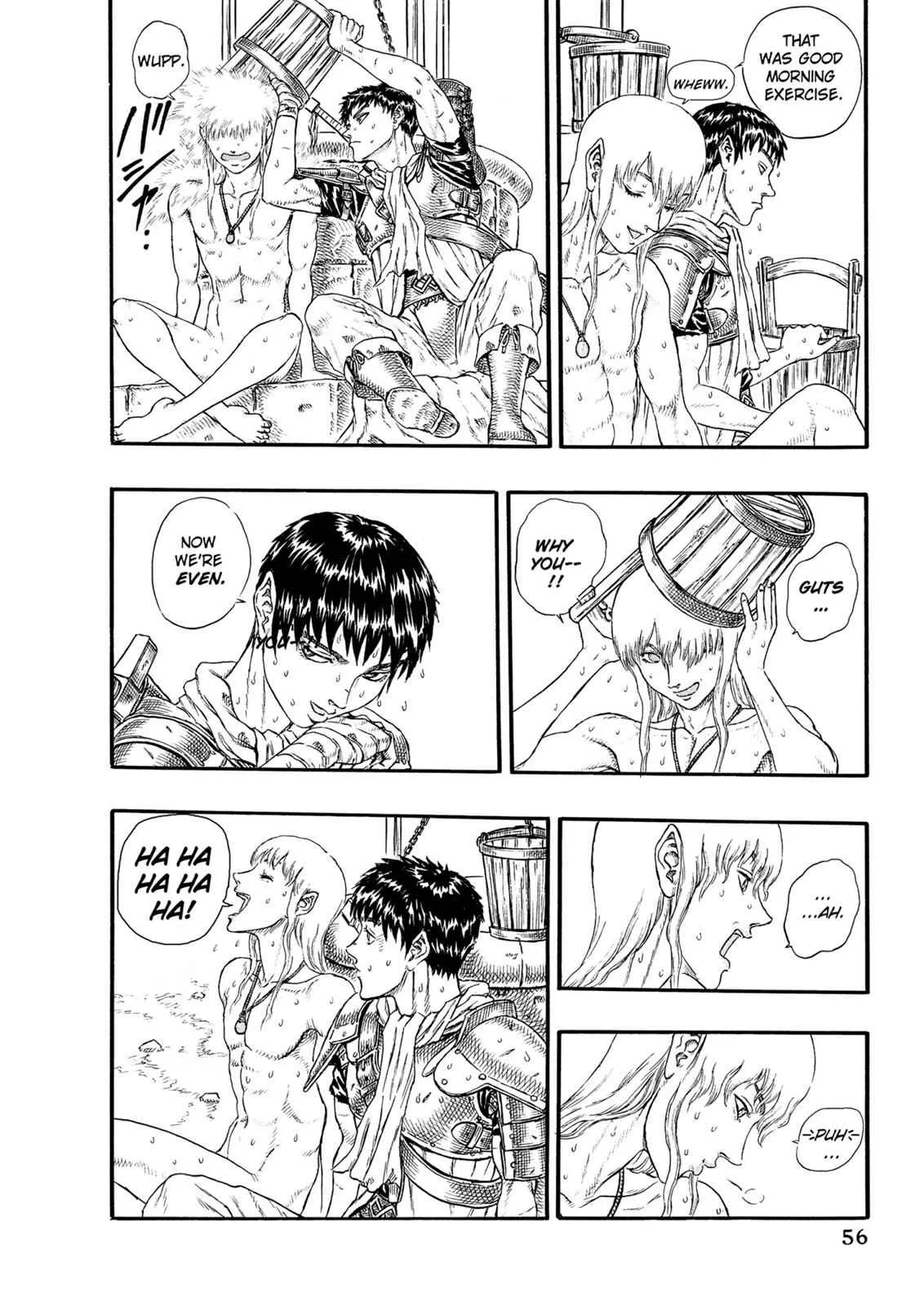
–if Griffith didn't, at least a little bit, really mean it?
And there's more, little despairs that recall nothing so much Maya's Instrumentality in End Of Evangelion, but at such a density i've never seen. Corkus lies that the Hawks were invincible before they met Guts. That's not true. Guts killed the general who hired them, causing them to lose the battle. That's how he caught Griffith's eye in the first place, and the only way he crossed paths with the Hawks. If it was as he said, Corkus wouldn't have had the chance to get so upset here.
There's Judeau playing matchmaker for Casca and Guts, because he really, truly loves Casca, while also understanding himself to be a jack-of-all-trades, good-enough-at-none. i don't think he's as close to Guts as he wants to be. Much earlier, he talks to Guts about life with the Hawks, how even with the threat of death on the battlefield they can laugh, cry, get angry; Guts is and has been so estranged from that kind of life that the appeal of the promise is totally alien.
The force that gathered these people together was the same within Griffith that allowed him to carry the Egg of the King to its hatching. It incubated in the warmth of the bonfire of dreams he collected around him. All of these people who would have been lost without Griffith and his love for Guts, died in terror without even knowing what changed. They were saved from mundane deaths, given safety and joy and allowed to grow, until someone else couldn't take it anymore. The laughter, tears, anger, the humans they became, some of them for the first time, were only possible because they were fated to pay for it with the worst things that can happen to a person.
Gambino's last words to Guts were "you should have died." They echo in his nightmares. This is both a strong character motif and serves as a superlative example of the kind of survivor's guilt (or more general feeling that one's time is up) that commonly happens with the kind of lifelong trauma Guts has. Keeping that in mind, doesn't it feel so perfectly cruel to call this arc the "Golden Age," when it's set in a world that cannot be returned to after its events ?
Guts leaving the Band of the Hawk up until the start of the Eclipse was easily the most interesting and emotionally evocative stretch of the anime. It's one of the more firmly contemplative, depicting a time of self-discovery for Guts following a return to his old wandering ways out of grief for his dream. It makes total sense that the seeds of later chapters' philosophical intrigue would be planted here.
Even as i tried to forget what i knew would happen after the Eclipse, i couldn't help but notice glimmers of it settling already in Guts and Griffith's time apart. The blacksmith Godot's speech about how he accepted the family trade of blacksmithing, lost his dreams and only loves the sparks–of course Guts realizes he's really being spoken to about his own life right afterwards. At the same time, Griffith experiences a dark mirror of this scene, in another room dimly furnace-lit. His torturer speaks with zeal and lust for pain and blood and chases it with an exaltation of the light and life leaving the eye.
While Godot passionlessly labored for the sake of an aloof stranger's sword, or will, the unnamed torturer savors the process of peeling Griffith's ambition away. Between them, Griffith's own philosophy would valorize his mutilator, although it is the dreamless and dead swordsmith inspiring the climb to equal standing he so spoke of valuing. In the end, both are creating "swords" which will cut through the imposition of causality, either the will of Femto of the God Hand or Guts' very literal blade.
At the end of the day though i have a newfound respect for the limited scope of the '97 anime. Not just for the artistry on display, i've written about that before on my old blog. Rather, the slice of the story that is adapted feels more significant than just "the obvious choice." The Golden Age really is that good. i can confidently say that in a way i feel i couldn't before, at least with more depth and detail as to why. But despite that, and all i've just said about it, it's nowhere near my favorite arc in Berserk. Soon enough, i'll be able to explain that too; for now, i'm off to go reread some more of the manga. Thanks for reading my blog !! If you're wondering where i've been, you can find the answer on my Ao3 page.