 -------------------------------------------------------------
notably, i havent been able to play a lot of games recently for personal reasons, so the ones i can give my time and attention to are all really special for very clear reasons in my mind. right now, i've been playing through Persona 2 and reading Higurashi, as well as grinding Umamusume like i'm possessed; all of those are great, but i haven't experienced enough of them to call them favorites yet. As for the games that i actually can include on this chart, they tend to have a strong sense of atmosphere in common, which probably explains why they've stuck with me so long.
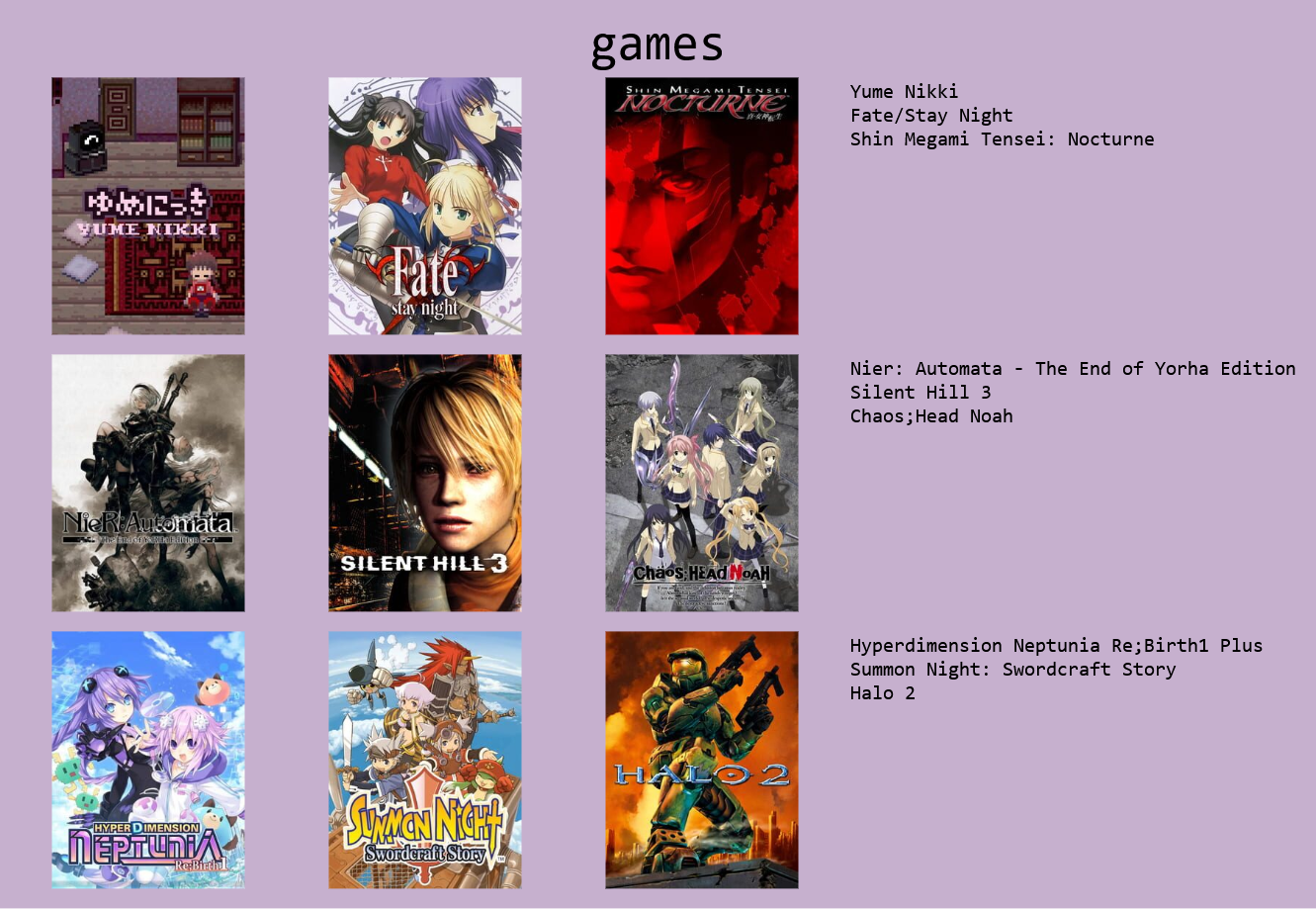
As ever, my favorites are unordered, but i think about Yume Nikki more than any other game. It wouldn't be unfair to say it's the most interesting i've played. It's also the one story i refuse to spoil. That story itself is incredibly abstract; most concretely, we play as a hikikomori who can only escape from her circumstances through dreaming. When you walk up to the front door, it's impossible to open, but when you sleep, it opens up to twelve different worlds. Each is totally different and completely surreal. From here, it's easy to get sucked into the adventure game mechanics, but please be sure to play through at least once without using a guide. It's easy to get lost in Yume Nikki, so it's easy to play. It's an adventure game in the sense that you explore it as much as possible, wring exciting and unique memories from every corner. It almost feels like a game designed around social play, but given its themes of isolation, it's really more a game about slowing down, making sense of time spent by oneself and maybe even learning to enjoy it. Well. Throughout so many different landscapes, there's such a strong uniting sense of atmosphere, the impression of... well, turmoil, given the one other concrete element of the narrative i would hazard to call it "learned self-loathing-unto-dissociation." Everything in this game is about the specifics of Madotsuki's psyche, in an incredibly abstract way, sometimes literally in just shapes and colors. i love it. Character is my favorite element of narrative art, and it's one games have a unique challenge in excelling in–especially this "art game" that borders on non-narrative. It's pretty easy to make a blank-slate player protagonist in something like an RPG; it's hard to make a game into a character study, right ? Especially if you're using the medium to the fullness of its unique potential, and not trying to emulate another medium like cinema, "but interactive". Yume Nikki takes the approach of exploring a surreal mental world used to lay out its characterization in abstract symbols and sometimes-psychoanalytic metaphors. It's an ingenious technique here; we don't want to see the adorably pitiful Madotsuki's life framed like a backstory to her suffering, nor do we want the game's premise explained to us in dialogue, but she's our main character, and she deserves understanding. So we walk with her. We see the way she thinks in dark, beautiful abstraction; we understand her a little better, or we do not. When we collect everything we can from the surreal depths, and choose to stop looking, the game ends.
Fate/stay night is a story i've written about a lot. Nasu's work in general was very formative to me, as i've probably made clear; Fate/stay night (Saber's route) in particular gave me the words for a lot of the regret and indistinguishable longing of that time, not just in Saber's memories of her death and life in a lie, but in Shirou's day-in-day-out grind to iterate on his father's ideals. Unlimited Blade Works actually showing the process of realizing those ideals, and then showing the cost of putting them into action in Heaven's Feel... The price of this disc's heroic golden end being self‐sacrifice feels right for all Sakura's been through. It's a different kind of self-sacrifice than Saber's quest for the Holy Grail, though; there's no regret in it. Where Saber's heroics were part of a complex she developed trying to be herself, ruler of England, in a society that wouldn't allow her to be herself as a woman, Shirou's come from genuine, immaculately stupid reflex. He's fine sacrificing himself for anyone in danger. Sakura is safe, so this isn't a bad outcome. There is no tension of regret to snap, though both are heroes. Aside from the characters themselves, the way Fate explores their powers and rationales for each of their distict paths towards becoming Heroic Spirits has sort of baked itself into the way i think by virtue of its complexity (Or however it keeps conversations interesting for dozens on dozens of hours.)
The larger Megami Tensei franchise is probably my favorite game series of all time. Persona 5, for all the fault many find with it, changed my life with its depiction of Akihabara; SMT IV was the perfect offroad from there to the grueling dungeon crawls the mainline is known for. i've emulated fan translations of the first two SMT games, too, and played a good bit of Persona 4 as well as 3 and Innocent Sin, that last one probably being my favorite Persona. Well, SMT IV has a very dear place in my heart, but i was always most interested in playing Nocturne. Being stuck on the PS2 for so long, and with me having no way to emulate that one system, it gained a certain mystique. The world is so surreal in ways that i can almost ground myself in–it's a wasteland, with towns–but then it slips away somewhere between "myth" and "dream"; it's a desert, with ruins inhabited by Manikins. And the Demifiend's spiky hair, shorts and skate shoes make for such a satisfyingly period design to the game's early 2000's development window. He wouldn't have looked out of place in a lot of the moshpits i was in back in 2019, either; point is, it's an enduring if perhaps not entirely timeless look, but that's what made it catch my interest. The game itself lives up to how hard the name "Demifiend" goes in how well it features transformation; as the game goes on and the player determines a route, that route's "Reason" will warp its most prominent follower in accordance with how they have changed as they've become closer to being ideologues. It also does really interesting things with the series staple Law vs Chaos ending system, getting close to realizing the full potential of it before SMT IV ultimately subverted it fully. The "Reason" most associated with Law is in favor of absolute rule by an inevitable and all-consumed peace, and the one closest to "Chaos" believes the weak should be ruled by the strong. Either way you slice it, it's absolute rule–and the third option is not much better, each soul totally contained in its own world with absolute dominion over its illusory surroundings. More than living up to my excitement, it challenged me and met my curiosity with genuine intrigue. It's a game as intelligently written as it is visually pitched to the emo crowd and for that it'll always have my heart.
It's intimidating to talk about a game as discussed-to-death as Nier Automata. You don't need me to tell you how well-written a Yoko Taro game is, so i won't restate the same things everyone else has already said. For all its acclaim, though... well, its existential themes of self beyond rebirth blew my little mind wide open about a year into transition. For all that's happened since, i'm sure it would resonate even deeper; i can't wait to replay it. But what really stuck with me about Nier Automata was, as could probably be expected, the atmosphere. It makes these relatively standard beats and points for robot SF stand out a lot more than they otherwise would when they take place in such nostalgic vistas. In many ways beyond just the lexical, its themes of becoming and remaining human as a constructed lifeform, it recalls Ghost In The Shell, which very obviously understands the importance of aesthetic tone to fully conveying a complex, heady narrative.. The words "desolate cityscape" tell you everything you need to know about the center of the map, and if it didn't, the track City Ruins from the score does. Maybe an example would explain it best. Nier Automata is one of the few games with a hunting mechanic where i don't get completely sucked into grinding out any animal i come across. It feels wrong do do anything but stay my blade in a place like this, not just in a moral sense but also in a mechanical one. It's the only game i've played where the fishing minigame matters for anything besides completion, or where most things in and about it matter for more than just progression, to me. The world itself has such a contemplative atmosphere that it forces me to think about all of it more, so it garners additional meaning–"Significance," if you will, the title of another standout from the game's score.
i think i said everything i could about Silent Hill 3 here and i really dont want to just repeat that here, so i won't.
Chaos;Head hit me at just the right time in my life. Thinking about how far I've come since back then, and how much i had to struggle to be heard with the people i hung around, as something more than just an easily dismissed delusionalist... well, i suppose it makes sense why a story about a reclusive otaku struggling with reality would resonate with me. Mostly, though–and i still haven't read that many VNs. but i'd read even fewer back then–the Delusion Trigger system stuck with me as one of the best implementations of VN mechanics in storytelling. Like with Yume Nikki, a game about mental illness should still include aspects of player choice in how the narrative proceeds. It's important to maintain agency for these characters, if for no other reason than narrative complexity; it's more interesting to have a character who can respond to their circumstances. How they respond, or how the player would have them respond, reveals more about the world. In so directly tying the choice to the result–in choosing to "look for" delusions, "good" and "bad", the player is able to experience a lot of the satisfaction of the visual novel medium (thorough exploration of a world/"scenario" via player choice) in a dense, thematically coherent package. It's also stuck with me just how interesting of a visual it is–these small sparks of light flitting around the corners of your vision are your choices. These small hallucinations are the only thing that may alter the scenario going forward. Even just as a visualization of mental illness, it's a strong choice. As anyone who's played Clannad will tell you, these games with lots of heroines and even more loss are about little balls of light. Oh, and speaking of, Ayase is the best. Her goth-punk fashion sense is impeccable and she's just so cool, and Phantasm's insert songs slap. Ehe... can you tell it's been a while since i read this one ? i'll re-read it soon, and write about it in more detail, because i'm sure i have more to say.
Neptunia Re;Birth 1 was very simply, a game i found all on my own. It wasn't that i found a video that mentioned it, or found someone talking about it online. i think it was literally linked on the Wikipedia page for moe anthropomorphism at a time when i was reading as much as i could on anything related to otaku culture, so of course an RPG about bishoujo-ified game consoles was going to catch my eye. By the time i was actually able to track down a copy, i was at a point where my depression was starting to eat away at my curiosity, the same force that led me to discover this game, but actually playing it, the bright colors and warm atmosphere both healed me and reminded me what its all about. Neptunia Re;Birth is a lot like Haruhi to me, in that both stand as reminders to me of the importance of trying hard to have fun. i couldn't even say how much of that is from the game itself, though it's pretty difficult to conceptualize a game more in my strike zone than an RPG with an all-bishoujo main cast who are constantly yuri-teasing each other. The setting is pretty interesting too, it feels like a fairytale world by way of Tron. Digital dreamlike, ephemera in the internet age, which makes sense given the Sega Neptune (the console supposedly serving as basis for our heroine) never existed. Also, while i haven't played the original game, the Remake System added for Re;Birth adds so much complexity, depth and replayability that it distinguishes Neptunia as a series from any other RPG long-runner i've played besides maybe Disgaea. It's really remarkable how much of an identity was added to this series only upon being remade; it's the gold standard for game remakes in my mind for that. A lot of the times RPGs stand out to me for entirely personal reasons; i connect with the atmosphere, or a certain character will hit me at the right time. With Neptunia Re;Birth, that's not-not a factor, but in conjunction with its mechanical depth it has the makings of a favorite.
The Game Boy Advance has been my favorite piece of gaming hardware. ROB the Robot has a more special place in my heart, but he's not hardware, he's my buddy. Either way, Summon Knight Swordcraft Story perfectly exemplifies the charms of the GBA; it might not be the most interesting game on the system to me but it has a transcendent charm that has made it stick close to my heart for many years. There's so much charm in the details. The player character's run cycle and both her and Sugar's dialogue portraits are the kind of moe-moe that never leaves you. It's such a cute game, relaxed without ever being lullingly cozy. Well, Dragon Quest is a comfort series to me. i wholeheartedly love generic mechanics and tropes in my JRPGs. There's a real wandering sense about it; unlike a lot of RPGs featuring missing parents, this one really feels like it. Not to say that it's gonna make you cry or anything, but there's a real sense of melancholy in the details. The player character portraits always seem a little dazed. Her interactions with Bron really feel like he's a part of the village raising this child, so to speak. His efforts to be there for her are shaky with grief, but no less determined–and all the more moving–for it. Speaking of character interactions, most people know this game for the aforementioned Sugar's route. The yuri is... well, there's a lot of really stupid discourse about it, if it even counts. The girl player character was such a late addition they didn't have time to change the romantic route with Sugar, the only Guardian Beast worth going for, so some people will argue it doesn't really count as a yuri work. However, in localization, they had the full game in front of them, and they chose to emphasize that Sugar would love the player character if they were a boy or a girl. A lot of hay has been made about "playersexual" characters and as with most discourse i think it loses sight of the core idea. It's really sweet that this character loves you, the player, no matter who you are.
Halo 2 is probably the least complicated game on my chart. CE is already about as good as a console shooter from 2001 was ever gonna be, it has really dense space opera lore for a single (again, console FPS) from that time, while also never slowing down the shooter action. It's near peak. Halo 2 just takes all those elements and steps them up. Humanizing the Covenant has always been a contentious choice with the more action-focused side of the fanbase, but for my money Halo is as much "war as hell" (down to ODST's references to Dante's Inferno in New Mombasa) as it is about "killing aliens and not afraid of anything". In a time when a lot of media about war was dumbing itself down to "realism" in order to appeal to the widest possible audience, Halo 2 deliberately narrowing its scope on a more complex narrative surrounding both the idea of "the enemy" and the enemy–the Covenant's–own internal politics reads as a definite choice, and a strong one for one of the biggest military SF series to take on its second installment. But if Halo 2 were just a more interesting story... The gameplay also gets a major kick in the ass. i don't think it's a stretch to say that while CE approached boomer shooter levels of frantic action, Halo 2's addition of dual-wielding bore its generation of FPS into a bespoke style of chaos. i'm using genre terms loosely here; the point is, it feels badass to play. If "switching to your sidearm is always faster than reloading," switching to your fallen enemy's needler in your off hand has to be a whole new level of speed. Speaking of, i understand why it got nerfed in Halo 3, but the versatility in how many weapons available for dual-wielding really made it feel like playing as humanity's strongest cyborg supersoldier, easily hefting infantry weapons like SMGs and Needlers in one hand each. It's such a solid bridge between the last of a new era in CE and Halo 3 as one of the first steps in console shooter's dominance, while being unique in that interstitial position. Nothing else feels quite like Halo 2, and certainly no other game has as hard of a Breaking Benjamin needle drop. -------------------------------------------------------------
Thank you very much for reading !! i'm probably gonna write about Umamusume next and then get back to my personal canon posts. Till then !!